Showing posts with label the minories. Show all posts

Saturday, December 28, 2019

2019 Recap

As 2019 comes to an end I look back on the exhibitions, events and publications which I have featured in. This year was a bit different from the others as it was the first year that I have been out of education. The year has been spent working out how to juggle being a practising artist, with real life commitments. 

Scroll down to see what I have been up to!

58th Essex Open Exhibition
‘This Way’
Beecroft Gallery, Southend
29/11/12 - 16/12/19


Poetry Sound Collection
‘Page Forty Three’
Poetry Sound Library Online: https://poetrysoundlibrary.weebly.com/
19/01/19 – Present


WOTISART?
‘done’
Art Magazine
February Edition


Unfamiliars: On Wonder
‘WONDER’
The Minories, Colchester
22/03/19


Secret Art Sale
‘you are here’, ‘you are here’
The Minories, Colchester
29/03/19 – 30/03/19


Harwich Shorts
‘Word-by-Word’
Harwich Festival
20/06/19 – 30/06/19


Colchester Art Society Summer Exhibition
‘Playing Cube’, ‘String Words’
The Minories
21/06/19 – 26/07/19


Unfamiliars: On Friends and Family
‘Communication Cards’
Odd One Out
28/06/19


The Travelling Sketchbook
‘turn over’
SPACE Colchester
18/07/19


Communication Cards
‘Communication Cards’
Edinburgh
10/08/19


Lowland
‘Its’, ‘Layers’
Ateliers Künstlerhaus Stuttgart, Reuchlinstr. 4b
06/ 09/19


Polemical Zine
‘PLAY’, ‘FUN’
Online
01/10/19


Coastal Open
‘x’, ‘to the sea’
Jaywick Martello Tower
12/09/19 – 27/10/19


Colchester Art Society
‘Playing Cubes’
Beecroft Gallery
07/09/19 – 02/11/19


Falling Walls
‘Road Sign Postcards’
SVA Gallery / Nau Gallery
01/11/19 – 16/11/19 / 04/12/19 – 10/12/19


Museum of Human Kindness
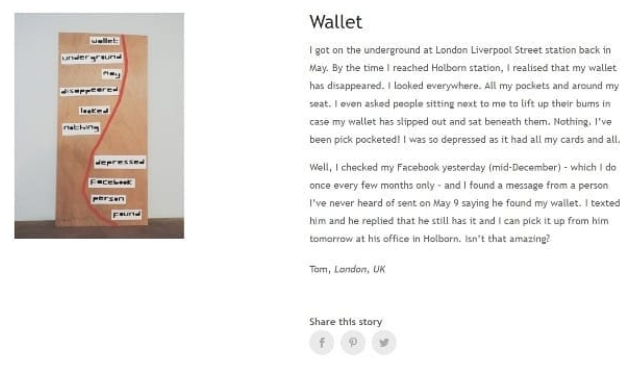
‘Wallet’
Online
13/11/19


Folds
‘Paku-Paku’
Lewisham Project Space
20/11/19 – 01/12/19


Colchester Art Society Winter Exhibition
‘Page Forty Three’, ‘PLAY’
The Minories
07/12/19 – 31/12/19


New Emergence Art
‘Playing Cubes’
newemergenceart

16/12/19


2019 was also an exciting year for the Creative Practitioner Support Programme (Previously known as the Graduate and Creative Practitioner Support Programme).

We completed out first year of peer-to-peer feedback sessions, hosted a Collaborative Installation Residency and started our second year of peer-to-peer feedback sessions.


To find out more about the Creative Practitioner Support Programme visit our Facebook page: https://www.facebook.com/groups/269213273718843/

Thank-you for your support in 2019, here is to an exciting 2020!

Tuesday, December 10, 2019

Page Forty Three

As part of the Colchester Art Society Winter Exhibition I am showing two language-based works. This blog post will explore the first of these, Page Forty Three. Page Forty Three has been a side project that I started earlier in the year. Read about the process of creating this piece of work below.

This project came about out of a studio experiment in which I set myself some arbitrary rules to follow. Linguistics continues to play a part within my practice and in my studio, I keep a stash of old books (because as a text artist it is good to be surrounded by text). I knew I wanted to do something with the books and with the notion of editing and changing the meaning of language. I was keen to break some linguistic rules and bring humour into the work.


The process started simply - I picked the first book I came to out if the box, opened the book and took the page out. At this point there was not process involved in picking the page number (as the title of this project suggests the page number of this randomly picked page was page 43). I then edited each sentence with a black marker pen. Censoring all but one of the words on each line. Leaving only the 1st, 2nd 3rd, 4th, 5th and 6th word respectively as I moved down the lines, allowing me to start to break up the language and push it to its limits (Deleuze, 1997). This number system added some structure to something otherwise random. It also set as a starting point, to create a system which could be reused and easily followed in subsequent pages used.


I was not overly taken with the aesthetics of the page-marker pen result. However, found the remaining text to be interesting and humours. I have a long-standing love for Dada and this plays into that perfectly. It allowed me to bend the usual linguistic rules of our shared public language (Wittgenstein in Kripke, 1984) and start to separate the text from reality. The words left give an insight into the content of the page they are taken from but are nonsensical and do not read particularly easily. This gives the work a playful edge as we are creatures of making sense of things (Peirce, 1931-58), but the outcome makes this difficult to do. We are usually apt at working out what things are supposed to mean and so the audience may still find some meaning in the words.


Having previously developed font ACcomplete4 I typed the words up. This further removed them from their origin and put a stamp of recognisability to them in relation to my practice. The words become easier to read and digest once typed as they became their own entity and appear at first glance as if there is a logical intention behind the word selection. Which is then dashed once the work is read. 


The decision to record the words came from wanting to create something that engaged more than one sense. It also felt relevant due to the tradition of reading stories aloud allowing for more than one person to be reached at a time. The work becomes a Dadaist story time. Within The Minories Page Forty Three is provided for listeners on a headset allowing them to become enveloped in the experience. The performance of the words is intentionally as smooth as possible, to give the initial impression that they are logical and follow linguistics rules and expectations. However, in reality the recording process become difficult as I tripped over the delivery of speaking words in a sequence that held little sense.


References

Deleuze, G. (1997) Essays Critical and Clinical. University of Minnesota Press.

Kripke, S. (1984) Wittgenstein Rules and Private Language. John Wiley & Sons; New Ed edition.

Peirce, C. S. (1931-58) Collected Writings (8 Vols.). Ed. Charles Hartshorne, Paul Weiss & Arthur W. 

Skinner, B. F. (2002) Beyond Freedom and Dignity. Hackett Publishing Co, Inc. Revised Edition.